


OMIM ID:
Weill-Marchesani Syndrome 2
Alternate Names
Defective Genes
Clinical Characteristics
Ocular Features
Glaucoma may have an infantile onset and pupillary block glaucoma is a lifelong risk. The lenses dislocate inferiorly but may migrate into the anterior chamber. Spherophakia occurs in 74% of patients. Extreme myopia in the range of -13 D may be present. There is an increased risk of retinal detachment.
Systemic Features
One patient had mitral valve insufficiency. Midface hypoplasia with a protruding lower lip was found in two patients. The elbow and perhaps other large joints have limited mobility and the interphalangeal joints are thickened with difficulty in full extension of the fingers. Patients are short in stature and the digits are often short and stubby. The skin is tanned and thickened in places. Cardiac anomalies are present in 13% of patients.
Genetics
Inheritance
This is an autosomal dominant disorder resulting from heterozygous mutations in FBN1 (15q21.1). It is thus allelic to the Marfan syndrome (154700). Weill-Marchesani syndrome 1 (277600) is a clinically similar syndrome but results from homozygous mutations in ADAMTS10. Homozygous mutations in ADAMTS17 cause the Weill-Marchesani-Like syndrome (613195).
Some individuals with isolated autosomal dominant ectopia lentis (129600) have mutations in FBN1.
Pedigree
Autosomal dominant
Autosomal dominant disorders require only one mutation for the disease to be expressed. Since an affected parent has two chromosomes, only one of which has the mutant gene, parents can expect that half (50%) of their children will receive that one and inherit the disease. It is common for individuals that inherit the mutation, however, to not have evidence of the disease (nonpenetrance).
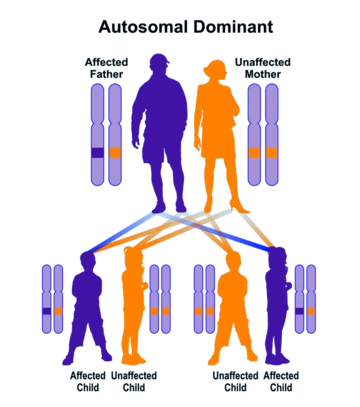
Autosomal dominant inheritance leads to a vertical pattern of transmission